Filtering Working Papers

10-07

Vikas Agarwal, Gurdip Bakshi, Joop Huij

Do Higher-Moment Equity Risks Explain Hedge Fund Returns?

Hedge funds are fundamentally exposed to equity volatility, skewness, and kurtosis risks based on the systematic pattern and significant spread in alphas from the existing models that do not control for the higher-moment risks. The spread and pattern in alphas do not disappear with bootstrap simulation, Bayesian analysis to account for potential estimation error, adjustment for backfilling bias, and the inclusion of additional systematic factors. Significant cross-sectional variation in higher-moment exposures is observed across fund styles with equity-oriented styles displaying more extreme exposures. Investable higher-moment factors explain the time series behavior of returns of a large number of Managed Futures, Event Driven, and Long/Short Equity hedge funds. Average exposure sensitivities for higher-moment factors are statistically significant in an estimation that accounts for style fixed effects and fund random effects.

10-08

Vikas Agarwal, Vyacheslav Fos, Wei Jiang

Inferring Reporting-Related Biases in Hedge Fund Databases from Hedge Fund Equity Holdings

published in: Management Science, Vol. 59, 2013, 1271-1289.
DOI: 10.1287/mnsc.1120.1647

This paper formally analyzes the biases related to self-reporting in hedge fund databases by matching the quarterly equity holdings of a complete list of 13F-filing hedge fund companies to the union of five major commercial databases of self-reporting hedge funds between 1980 and 2008. We find that funds initiate self-reporting after positive abnormal returns which do not persist into the reporting period. Termination of self-reporting is followed by both return deterioration and outflows from the funds. The propensity to self-report is consistent with the trade-offs between the benefits (e.g., access to prospective investors) and costs (e.g., partial loss of trading secrecy and flexibility in selective marketing). Finally, returns of self-reporting funds are higher than that of non-reporting funds using characteristic-based benchmarks. However, the difference is not significant using alternative choices of performance measures.
10-09

Vikas Agarwal, Wei Jiang, Yuehua Tang, Baozhong Yang

Uncovering Hedge Fund Skill from the Portfolio Holdings They Hide

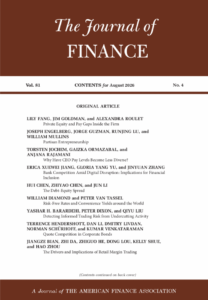
published in: Journal of Finance, Vol. 68, 2013, 739-783.
DOI: 10.1111/jofi.12012

This paper studies the “confidential holdings” of institutional investors, especially hedge funds, where the quarter-end equity holdings are disclosed with a delay through amendments to the Form 13F and are usually excluded from the standard databases. Evidence supports private information as the dominant motive for confidentiality. Funds managing large risky portfolios with non-conventional strategies seek confidentiality more frequently. Stocks in these holdings are disproportionately associated with information-sensitive events or share characteristics indicating greater information asymmetry. Confidential holdings exhibit superior performance up to twelve months. The probability of SEC approval is associated with the fraction of portfolios seeking confidentiality and the filer’s track records.
10-10

Stefan Frey, Patrick Herbst

The Influence of Buy-Side Analysts on Mutual Fund Trading

published in: Journal of Banking and Finance, Vol. 49, 2014, 442-458.
DOI: 10.1016/j.jbankfin.2014.01.007

We present evidence of the impact of buy-side analysts on the behavior and performance of fund managers. Using data provided by a large global asset manager, we relate buy-side analysts’ recommendations to fund transactions on a daily basis. Our results show that buy-side analysts have a significant influence on trading decisions: Fund managers almost certainly follow recent recommendation revisions in their trades. Fund flows and sell-side recommendations matter as well, but to a lesser extent. Positive abnormal returns to buy-side analysts’ revisions are also reflected in the performance of mutual fund trades: trades triggered by buy-side recommendations have higher returns than other trades.
10-11

Marc Chesney, Alexander Kempf

The Value of Tradeability

published in: Review of Derivatives Research, Vol. 15, 2012, 193-216.
DOI: 10.1007/s11147-012-9074-0

This paper determines the value of asset tradeability in an option pricing framework. In our model, tradeability is valuable since it allows investors to exploit temporary mispricings of stocks. The model delivers several novel insights on the value of tradeability: The value of tradeability is the larger, the higher the pricing efficiency of the market is. Uncertainty increases the value of tradeablity, no matter whether the uncertainty results from noise trading or from new information about the fundamental value of the stock. The value of tradeability is the larger, the longer the illiquid stock cannot be traded and the more trading dates the liquid stock offers.
10-12

Sabine Artmann, Philipp Finter, Alexander Kempf, Stefan Koch, Erik Theissen

The Cross-Section of German Stock Returns: New Data and New Evidence

published in: Schmalenbach Business Review, Vol. 64, 2012, 20-43.
DOI: 10.2139/ssrn.1652140

This paper serves two purposes. First, we introduce a new data set on the German stock market which is publicly available to all researchers. It comprises factor returns (a market factor, a size factor, a book-to-market factor, and a momentum factor) as well as returns of portfolios which are single- and double-sorted according to beta, size, book-to-market, and momentum. Second, we use this data set to perform asset pricing tests for the German equity market. Specifically, we test the standard CAPM, the Fama-French three-factor model, and the Carhart four-factor model. Our tests are based on a more comprehensive data set than earlier studies and we investigate the sensitivity of the results to the choice of test assets. Our results indicate that none of the models is able to consistently explain the cross-section of returns. They also demonstrate that the results of asset pricing tests are sensitive to the choice of test assets.
10-13

Stephan Jank, Michael Wedow

Purchase and Redemption Decisions of Mutual Fund Investors and the Role of Fund Families

published in: European Journal of Finance, Vol. 19, 2013, 127-144.
DOI: 10.1080/1351847X.2012.662908

This paper investigates the purchases and redemptions of a large cross-sectional sample of German equity funds. We find that investors punish bad performance by selling their shares, but also have a tendency to sell winners. Investors in large fund families show higher sales and redemption rates. Further family size also affects the flow-performance relationship: Investors in large families punish bad performance more. Last, we find that inner family rankings play an important part for redemptions, with investors strongly redeeming their shares from intra-family losers.
10-14

Joachim Grammig, Stephan Jank

Creative Destruction and Asset Prices

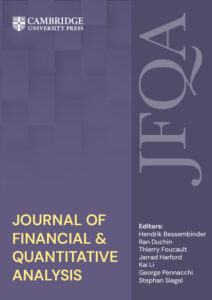
published in: Journal of Financial and Quantitative Analysis, Vol. 51, 2016, 1739-1768.
DOI: 10.1017/S0022109016000557

This paper introduces Schumpeter’s idea of creative destruction into asset pricing. The key point of our model is that small and value firms are more likely destroyed during technological revolutions, resulting into higher expected returns for these stocks. A two-factor model including market return and patent activity growth - the proxy for creative destruction risk - accounts for a large portion of the cross-sectional variation of size and book-to-market sorted portfolios and prices HML and SMB. The expected return difference between assets with the highest and lowest exposure to creative destruction risk amounts to 8.6 percent annually.
10-15

Gjergji Cici, Alexander Kempf, Alexander Pütz

The Valuation of Hedge Funds’ Equity Positions

published in: Journal of Financial and Quantitative Analysis, Vol. 51, 2016, 1013-1037.
DOI: 10.1017/S0022109016000351

We provide evidence on the valuation of equity positions by hedge funds. Reported valuations deviate from standard valuations based on closing prices from CRSP for roughly seven percent of the positions. These equity valuation deviations are positively related to illiquidity and price volatility of the underlying stocks. They respond to past performance and intensify after an advisor starts reporting to a commercial database. Furthermore, advisors with more valuation deviations show a stronger discontinuity in their reported returns around zero, manage a higher fraction of potentially fraudulent funds, report smoother returns, and exhibit an upward spike in their December reported returns.
10-16

Stephan Jank, Michael Wedow

Sturm und Drang in Money Market Funds: When Money Market Funds Cease to Be Narrow

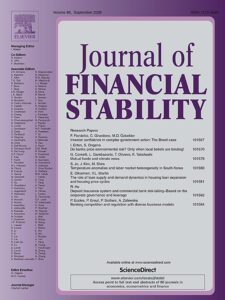
published in: Journal of Financial Stability, Vol. 16, 2015, 59-70.
DOI: 10.1016/j.jfs.2014.12.002

This paper investigates the returns and flows of German money market funds before and during the liquidity crisis of 2007/2008. The main findings of this paper are: in liquid times, money market funds enhanced their returns by investing in less liquid papers. By doing so they outperformed other funds as long as liquidity in the market was high. Investing in less liquid assets, however, widens the narrow structure of money market funds and makes them vulnerable to runs. During the shortening of liquidity caused by the subprime crisis, illiquid funds experienced runs, while more liquid funds functioned as a safe haven.