05-01
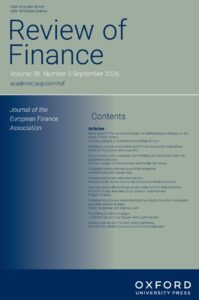
Stefan Frey, Joachim Grammig
Liquidity Supply and Adverse Selection in a Pure Limit Order Book Market
veröffentlicht in:
Empirical Economics, Vol. 30, 2006, 1007-1033.
DOI:
10.1007/978-3-7908-1992-2_5
Based on a structural model we analyze adverse selection costs and liquidity supply in a pure open limit order book market. Given the discontenting empirical model performance reported in the previous literature, we relax restrictive assumptions of the underlying theoretical model concerning order book equilibrium and the distribution of market order volumes. We demonstrate that the resulting revised econometric methodology delivers considerably improved empirical results. Employing the alternative approach in a cross sectional analysis we provide evidence that adverse selection costs are more severe for smaller capitalized stocks, and find empirical support for one of the main hypothesis put forth by the theory of limit order book markets, which states that liquidity supply and adverse selection costs are inversely related. We also show that adverse selection component estimates based on the formal model and those obtained using popular model-free methods are closely correlated. This result indicates the robustness of the structural model, but also provides a theoretical underpinning for the application of the ad hoc method to limit order book data.
05-02
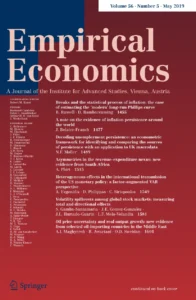
Alexander Kempf, Christoph Memmel
Estimating the Global Minimum Variance Portfolio
veröffentlicht in:
Schmalenbach Business Review, Vol. 58, 2006, 332-348.
DOI:
10.2139/ssrn.385760
Expected returns can hardly be estimated from time series data. Therefore, many recent papers suggest investing in the global minimum variance portfolio. The weights of this portfolio depend only on the return variances and covariances, but not on the expected returns. The weights of the global minimum variance portfolio are usually estimated by replacing the true return covariance matrix by its time series estimator. However, little is known about the distributions of the estimated weights and return parameters of this portfolio. Our contribution is to determine these distributions. The knowledge of these distributions allows us to calculate the extent of the estimation risk an investor faces and to answer important questions in asset management.
05-03
Mathias Hoffmann
Fixed versus Flexible Exchange Rates: Evidence from Developing Countries
veröffentlicht in:
Economica, Vol. 74, 2007, 425-449.
DOI:
10.1111/j.1468-0335.2006.00564.x
This paper investigates the formalisation that in a small open economy flexible exchange rates act as a ‘shock absorber’ and mitigate the effects of external shocks more effectively. An intertemporal small open economy model with nominal rigidities, in which real shocks generate internal imbalances under fixed and flexible exchange rates, is laid out. The role of world interest rate and world output shocks in driving output, trade imbalances and real exchange rate fluctuations is investigated. Using a sample of 38 developing countries, the paper assesses whether the responses of real GDP, the trade balance and the real exchange rate to world real interest rate and world output shocks differ across exchange rate regimes.
05-04
Mathias Hoffmann
Compensating Wages under Different Exchange Rate Regimes
This paper analyses the interconnectedness between developing countries’ domestic wage levels and their exchange rate choices. The theoretical model illustrates that differences in domestic wage levels are related to countries’ exchange rate regimes. In particular, the level of domestic wages increases with the rigidity of the exchange rate regime. The empirical model explores the determinants of the domestic wage level in a cross-section of 38 developing countries. In line with the theoretical model, the economies under review experience a rise in the domestic wage level with an increase in the rigidity of their exchange rate regime.
05-05
Héléna Beltran-Lopez, Joachim Grammig, Albert J. Menkveld
Limit order books and trade informativeness
veröffentlicht in:
European Journal of Finance, Vol. 18, 2012, 737-759.
DOI:
10.1080/1351847X.2011.601651
Electronic limit order books are ubiquitous in markets today. However, theoretical models for limit order markets fail to explain the real world data well. Sandas (2001) tests the classic Glosten (1994) model for order book equilibrium and rejects it. We reconfirm this result for one of the largest European stock markets. We then relax one of the model’s assumptions and allow the informational content of trades to change over time. Adapting Hasbrouck’s (1991a,b) methodology to estimate time varying trade informativeness we find that it is a slowly mean reverting process. By conditioning on trade informativeness, we find support for the Glosten model’s implication that books are more shallow during times of informative market orders. However, a high level of liquidity supply is committed up to an economically significant trade size volume, even when trade informativeness is high. This can be seen as a vindication of the open order book design which dispenses with dedicated market makers. We also find evidence for a market order trader population which is quite heterogenous with respect to price sensitivity.
05-06
Joachim Grammig, Erik Theissen
Is BEST Really Better? Internalization of Orders in an Open Limit Order Book
veröffentlicht in:
Schmalenbach Business Review, Vol. 64, 2012, 82-100.
DOI:
10.1007/BF03396891
This paper studies the market quality of an internalization system which is designed as part of an open limit order book (the Xetra system operated by Deutsche Börse AG). The internalization system (Xetra BEST) guarantees a price improvement over the inside spread in the Xetra order book. We develop a structural model of this unique dual market environment and show that, while adverse selection costs of internalized trades are significantly lower than those of regular order book trades, the realized spreads (the revenue earned by the suppliers of liquidity) is significantly larger. The cost savings of the internalizer are larger than the mandatory price improvement. This suggests that internalization can be profitable both for the customer and the internalizer.

05-07
Alexander Kempf, Stefan Ruenzi
Status Quo Bias and the Number of Alternatives – An Empirical Illustration from the Mutual Fund Industry
veröffentlicht in:
Journal of Behavioral Finance, Vol. 7, 2006, 204-213.
DOI:
10.1207/s15427579jpfm0704_3
We examine the extent of the Status Quo Bias (SQB) in a real-world repeated decision situation. Individuals who are subject to a SQB tend to choose an alternative that was chosen previously (i.e. their status quo), even if it is not the optimal choice any more. We examine the US equity mutual fund market and find strong evidence for the existence of a SQB in this market. Furthermore, the SQB is more severe in segments where there are more funds to choose from. Thereby, we deliver the first empirical confirmation of the experimental result of Samuelson and Zeckhauser (1988), that the SQB positively depends on the number of alternatives.
05-08
Stefan Ruenzi
Mutual Fund Growth in Standard an Specialist Market Segments
veröffentlicht in:
Financial Markets and Portfolio Management, Vol. 19, 2005, 153-167.
DOI:
10.1007/s11408-005-3383-3
This paper is concerned with differences in the performance-flow relationship (PFR) between standard and specialist market segments of the mutual fund industry. We expect differences in this relationship because investor characteristics might vary across different segments. Our results show that the PFR is more convex in standard segments as compared to specialist segments. Furthermore, investors in standard segments are less risk-averse and invest more in high-load funds than investors in specialist segments. Our findings are consistent with investors in standard segments being less sophisticated than investors in specialist segments and to rely more heavily on the advice of financial brokers, which is compensated for by load fees.
05-09
Mathias Hoffmann
Saving, Investment and the Net Foreign Asset Position
Over the last two decades, countries have exhibited net foreign assets and liabilities. This paper develops an empirical model to examine the causes for the stock of the net foreign asset positions in 51 developing and industrialised countries. The reasons for significantly high or low net foreign asset positions can be derived from long-run trend differences in saving and investment. Using cointegration techniques, it is shown that GDP per capita, public debt and demographic factors influence long-run saving and investment and, hence, net external wealth of developing and industrialised countries.
05-10
Michaela Bär, Alexander Kempf, Stefan Ruenzi
Is a Team Different From the Sum of Its Parts? Evidence from Mutual Fund Managers
veröffentlicht in:
Review of Finance, Vol. 15, 2011, 359-396.
DOI:
10.1093/rof/rfq014
This paper provides the first empirical test of the diversification of opinions theory and the group shift theory using real business data. Our data set covers management teams and single managers of US equity mutual funds. Our results reject the group shift theory and support the diversification of opinions theory: extreme opinions of single team managers average out and, consequently, teams make less extreme decisions than individuals do. We find that teams follow less extreme investment styles and their portfolios are less industry concentrated than those of single managers and that teams are eventually less likely to achieve extreme performance outcomes. These results hold after taking into account the impact of fund and family characteristics as well as manager characteristics. Additionally, teams exhibit a lower active share and lower risk levels, driven by a lower level of idiosyncratic risk, as compared to singlemanaged funds.